


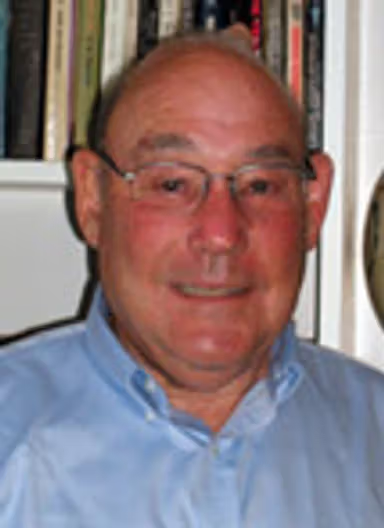
January 28, 2025: Richard Nelson died
We are sad to announce that Richard R. Nelson has passed away. Here is an obituary that the International Schumpeter Society sent out.
Dear ISS members,
It is with great sadness that we have to inform you that Richard R. (Dick) Nelson has left us. He passed away peacefully on 28th January 2025. A long and fulfilling life has come to an end, a life characterized by the highest level of scientific achievement, creativity and out-of-the-box thinking, and a broad-based desire for knowledge. Dick has launched a scientific life’s work that is unrivalled. Together with Sid Winter and others, he put the concept of evolutionary economics on a solid footing and thus set in motion an intellectual movement and school of thought that deals with economic phenomena from a dynamic and disequilibrium-orientated perspective.
Of course, Dick’s contribution to the discipline is crucial and moreover it is a contribution which since half a century has not yet demonstrated its full impact. But he had an incredible ability to educate (and not only to train) students and young researchers. Dick had this rare ability to mobilize attention and energy towards the most precise and relevant intellectual challenges, not only as a mentor but also and mainly through a deep and intense collaboration. And, almost independently from his contributions to the discipline through publications, his most long-lasting impact is and will be in the long term his influence on the personal intellectual trajectory of many of our colleagues.
Dick Nelson is not only an extra-ordinary teacher, he is also an efficient and remarkable “adviser’. From his participation in the RAND corporation to his more recent collaboration with OECD, we have to remember that he served on the Council of Economic Advisors of the President of the United States, a mythical place for economists, during a mythical period, the 60s. He was also head of an influential program on Science, Technology, and Global Development, at the Columbia Earth Institute, and Professor of International and Public Affairs, Business, and Law, at Columbia University.
Dick joined the International Joseph A. Schumpeter Society at a very early stage and took part in the 1988 conference in Siena for the first time. His ideas and concepts subsequently influenced the development of the Society. This also earned him the honorary presidency of the Schumpeter Society. With his oeuvre, Dick has influenced generations of scientists, accompanied and advised them and was always a great friend to them, with touching warmth and kindness.
We will miss Dick Nelson as a person as much as we will miss him as an intellectual pioneer, source of ideas and advisor. Our world has become a much poorer place. Our deepest sympathy goes to his bereaved family.
In deep mourning
Patrick Llerena (President ISS) and Uwe Cantner (Secretary General ISS)
b]Here is the obituary written by his family received on February 10, 2025.
Richard R. Nelson
Richard R. (Dick) Nelson, iconoclastic economist, dedicated scholar and mentor, and avid tennis player, died on January 28th after a short illness. He was 94 years old.
Dick was born in New York City in 1930. The family moved to the Washington, DC area in 1933 as his father, Saul, joined the Roosevelt administration. Dick’s sister, Joan, was born there. At the end of the war, Saul was recruited to work in Berlin to assist in the German economic recovery. Dick greatly enjoyed the two years the family lived in Berlin. This experience in other lands opened his mind and influenced his thinking as he became more of a scholar.
As a youth, however, Dick had little passion for school. He was a natural athlete, exceling in several sports. He loved popular music, played a little guitar, and worked as a DJ for the armed services radio in Berlin while there in high school. His dream was to become a sports announcer. His first two years of college were at the University of Wisconsin, where he was the quarterback of the JV football team. He credited his academic career to his athletic disappointments at Wisconsin: he found that he was too short to see easily over the front line, and after a few injuries culminating in a broken nose, he discovered he was in fact intellectually excited by the liberal arts program at the university. He became a life-long enthusiast of broad and deep reading of history. He transferred to Oberlin College, where he met and fell in love with a fellow student, Katherine (neé Johnson). Friends at Oberlin teased Dick about whether he minded that Katherine was “smarter” than he was, to which he always replied that in his view that was a positive. They married following their graduation.
Dick attended Yale University as a PhD student in Economics, studying under James Tobin. He developed an enduring interest in how technological innovation drives economic growth, and in how different technologies and industries emerge and evolve. He followed his degree with an unusual stint as a post-doctoral student taking classes in engineering and sciences at MIT. His first job after that was as a visiting professor at Oberlin, from which he was recruited to the RAND corporation in Santa Monica, California. In 1961 he was invited to join the staff of the Council of Economic Advisors to President John F. Kennedy, an experience he always treasured. He returned to RAND in 1963, where he focused on technological change and economic development in the US and internationally.
In 1968 he left Santa Monica to take a position as a Professor of Economics at Yale University. While at Yale he extended his interest in exploring, through empirical studies and theory, how inventions and innovations originated and affected different industries and sectors. He put science, basic and applied research and experimentation as engines of progress and economic growth. At the same time he gave a major role to public policy and institutions in stimulating and directing the rate and direction of technological change. During his Yale years, working closely with his friend and colleague Sidney Winter, Dick developed an evolutionary theory of economic change, which became the foundation of modern evolutionary economics. Evolutionary economics as Nelson and Winter conceived, is focused on learning, knowledge and firm capabilities: technological change and new actors introduce change in the economy, firm-level routines provide continuity in the industrial system and innovation and competition drive the selection process among different economic agents. From their collaboration Dick and Sid published An Evolutionary Theory of Economic Change, a volume that has not been out of print since Harvard first issued it in 1982. The book has became a landmark contribution in understanding economic change and industrial transformation and has diffused rapidly among social scientists, opening the way to a new view of looking at the economy and at economic growth. Evolutionary approaches to economic change and industrial transformation have been particularly influential among economists in Europe, and in many Asian, Latin American and African countries.
In subsequent work Dick focused on the role of institutions as fundamental drivers of economic growth, and on the institutional complexity of modern capitalist economies, with a variety of innovation systems and sectors shaping economic change and industrial transformation. He also addressed economic development as an evolutionary process. Dick’s impact as a scholar can be seen in his many books and articles, and in the enormous number of citations that quote his contributions. His impact is also clearly seen in the many collaborations he established with other scholars across the world, and in the large number of junior scholars he mentored with great generosity. Most of his closest friends were colleagues and collaborators; many were former students. He loved the process of intellectual collaboration both for the rich stimulation and for the sheer pleasure of sharing and developing ideas
Outside of work, Dick was a warm, puckish, loving father and husband. He had two daughters to whom he was devoted, and they returned that devotion: Margo, born in 1958, and Laura, born in 1961. In his first stint in Santa Monica Dick discovered tennis, and from the moment he picked up a racket it became a passion. Katherine yearned to have a meaningful career; with Dick’s enthusiastic support she pushed against academic misogyny to earn her PhD in Developmental Psychology at UCLA. She established herself as a scholar of child language development, cognition, and memory. Their marriage was filled with intellectually rich conversation. In the 1970s they designed and built a modest summer house on Cape Cod, where they spent every summer for the rest of their lives, gladly welcoming friends and family. When Katherine’s career drew her from Yale to the CUNY Graduate Center in New York, Dick gave up his position at Yale for a professorship at Columbia, where he worked until his retirement. Dick and Katherine enjoyed living on the Upper West Side for more than three decades. They were within walking distance of Lincoln Center, and they had season subscriptions to the chamber music series there.
After Katherine’s death in 2018, Dick moved to Albany, California to be closer to his children, but he never stopped reading, writing, thinking, and traveling.
Dick Nelson had a long and happy life, and he was well and widely loved.
Return to all News items
 Tell a Friend