
June 25, 2021: Nelson and Winter in Top 100 Economists
Richard Nelson and Sidney Winter have been listed by the French Magazine Sciences Humaines among to top 100 economists of all time. You can read here (in French) how the magazine portrays Nelson and Winter’s intellectual contributions. Nelson and Winter’s Ideas. English translation
June 16, 2017: Oxford business history course
Chris McKenna has shot a beautiful 5-min video introducing students what they will learn in a business history he runs at Oxford using Oxford and its environment as the material to be studied in the course. The chief assignment is to write a case that later can be used in class by other students. We highly recommend watching this video.
May 20, 2017: Sid Winter interview on new book “Innovation and the Evolution of Industries”
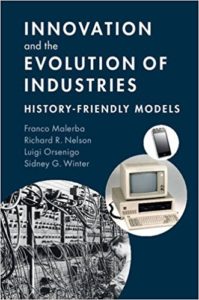
Sid Winter talks with Knowledge@Wharton about his new book on “history friendly evolutionary models”, which he co-authored with Franco Malerba, Richard Nelson, and Luigo Orsenigo. The book deals with the interactions between innovation and industry evolution. Winter gives a quick introduction to evolutionary economics and the scientific value of history-friendly simulations models. Read the transcript or listen to podcast here.
April 4, 2017: The American Corporation
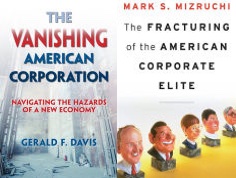
Two important books on the American corporation have been written by Gerald Davis and Mark Mizruchi. They are reviewed by a very thoughtful essay by Braydon King in Contemporary Sociology and by Bruce Kogut in a shorter piece in ASQ.
February 17, 2017: MOR Special Issue on ‘The Innovation and Entrepreneurship Eco-system in India’
This Management of Organization Review (MOR) special issue (edited by Suresh Bhagavatula, Ram Mudambi and Johann Peter Murmann) aims to explore the key features of the innovation and entrepreneurship eco-system in India. The objective of this Management and Organization Review (MOR) special issue is to explore the many dimensions of how the innovation and entrepreneurship eco-system of India. For details see, Call for Papers.
January 31, 2016: The Rise and Fall of American Growth by Robert Gordon
Robert Gordon has written an important new book in which is spells out his detailed arguments why he expects American economic growth never to reach the levels achieved before 1970. Here are links to useful reviews of the book:
1. Economist
2. Paul Krugman in NY Times Magzine
Jan 20, 2016: 2nd MOR Frontier’s conference: Call for Proposals
Building on the success of the first conference in Honk Kong, Management and Organization Review(MOR) will hold the 2nd frontier’s conference in Peking,China, October 5–7, 2016, and in Banglore, India, October 13–15, 2016. The theme of the conference is “The SME Ecology of Transforming Economies: Knowledge Creation, Entrepreneurship, Innovation and Economic Growth.” Panel Proposals are due March 31, 2016. For detail, see the Call For Proposals.
January 15, 2016: Call for Papers “Managing in the Age of Disruption”
The Journal of Management is calling for contributions to a special issue on “Managing in the Age of Disruption” The editors are
Shahzad (Shaz) Ansari, University of Cambridge, UK
Raghu Garud, Pennsylvania State University, USA
Arun Kumaraswamy, West Chester University of Pennsylvania, USA.
Deadline for Submission: 16. December 2016. Details
August 24, 2015: Nathan Rosenberg Obituary by Joel Mokyr
The economic history profession has lost one of its most original, creative, and wide-ranging minds in the passing of Nathan Rosenberg on Aug. 24, 2015. Rosenberg was one of the founding fathers of Cliometrics, a member of the first group of Cliometricians that with coining the term “congregated at Purdue University in the late 1960s, and which included other luminaries among them Lance Davis, Jonathan Hughes, and Stanley Reiter (who is widely credited Cliometrics”).
Read more...
July 27, 2015
China's economic development is one of the great stories of our time. Today (July 28, 2015) we are starting our special focus on China with a review new book on the development of China's innovative capacity.
China's Path to Innovation written by the Oxford Professor
Xiaolan Fu. Although a new trade press book seems to come out almost every week on China's innovative capacity, there are relatively few scholarly treatments on the subjects. For this reason, Xiaolan Fu’s book
China's Path to Innovation (Cambridge University Press, 2015) is a welcome addition to the literature.
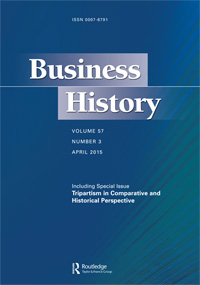
July 12, 2015 Special Issue on Deepening Links between Business History and Evolutionary Economics
We reported earlier on a conference bringing together business historians and evolutionary economic in Dublin. A set of papers that have grown out of the conference are not appearing as a special issue in the journal “Business History.” The contributors are: Michael Jacobides, Franco Malerba & Luigi Orsenigo, Johann Peter Murmann, Richard Nelson Ray Stokes & Ralf Banken, Steven Toms, Nick Wilson & Mike Wright, and Jim Quinn. You can find the papers and links for downloading here: Special Issue Papers
May 23, 2015. Sid Winter wins Global Award for Entrepreneurship Research
Sid Winter just won the 2015 Global Award for Entrepreneurship Research for “his deep empirical understanding of Schumpeterian processes of dynamic competition, generation of differential technological opportunities through appropriability conditions and the mechanisms driving dynamic capabilities in firms.” Full story. New: Winter’s Prize Lecture now available for download.
Feb 18, 2014: Inaugural MOR Frontiers Conference in Hong Kong
Management Organization Review has a new editor: Arie Lewin. Professor Lewin has many plans for taking the journal to the next level. One of them is to hold an annual conference to explore new ideas. MOR will hold its first Frontiers Conference “Globalization of Knowledge Creation and Innovation in the Context of Emerging Economies” in Honk Kong Dec 4-7, 20214. Here is the call for your participation.
June 20, 2013: Steve Klepper in Memoriam
We are all very sad that Steve passed away (See CMU obituary). Seven Klepper supported one of the senior scholars supporting the creation of economic-eovlution.net from the very beginning. On March 23, there was at event as part of the 20th anniversary of the CCC to honor Steve. He was able to attend the day and you can watch the tributes that were made about it exemplary contributions. Honoring Steve Klepper Video.
May 29, 2013: Announcing “Letters from China”
Your editor is traveling to China. The goal of the visit is to get a deeper understanding of what the future of China will likely look like. More specifically, the purpose is to become more knowledgeable about whether China will become the world leader in high-tech industries and if so how. Read his “Letters from China.”
Jan 22, 2013: Emerging Scholar Workshop: Evolutionary Perspectives on Strategic Management
The Mack Center for Technological Innovation at the Wharton School will put on for the 2nd time a new week-long workshop for emerging scholars in the field. The workshop is designed for scholars ranging from students who are completing the second year of doctoral studies to those who have recently completed a doctorate. Participants will learn from leading scholars in the field. The program will consist of a mix of seminar discussion and short presentations by participants reflecting their research interests and reactions to the seminar discussions. The program will begin on Sunday, June 23rd and end on Friday June 28th. Each day will consist of a three hour workshop lead by an individual faculty member on the indicated theme, followed by broader group discussion. Deadline for application Feb 15, 2013. More details here.
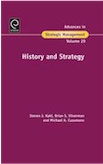
September 8, 2012: History and Strategy
The new volume of “Advances in Strategic Management” entitled “History and Strategy” is focused on bringing about stronger integration of history in strategy research. Edited by Steven Kahl, Brian Silverman, and Michael Cusumano, the book contains 10 articles that sketch how this deeper integration could come about. If you university library subscribes to Emerald, you can download the chapters from the Table of Contents.
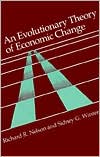
May 15, 2012: Perspectives and Reflections on Nelson & Winter (1982)
The 9th Atlanta Competitive Advantage Conference had a panel to celebrate the publication of Nelson and Winter’s 1982 landmark book. The panel included Sid Winter, Connie Helfat, L.G.Thomas III, and Johann Peter Murmann. The slides from the panelists are here: Helfat’s Presentation Slides
Murmann’s Presentation Slides
Thomas’s Presentation Slides
From the vault: Winter on Nelson (2000)
Nelson on Winter (2003)
March 26, 2012: New Work on Coevolution
Johann Peter Murmann has published an inductive case study entitled Coevolution of Industries and Important Features of Their Environments. Using a comparative historical method and drawing on evidence from five countries over a 60-year period, this paper spells out how coevolutionary processes work in shaping the evolution of industries and important features of their environments.Read the abstract and download paper here.
Jan 26, 2012 Emerging Scholar Workshop: Evolutionary Perspectives on Strategic Management
The Mack Center for Technological Innovation at the Wharton School will put on a new week-long workshop for emerging scholars in the field. The workshop is designed for scholars ranging from students who are completing the second year of doctoral studies to those who have recently completed a doctorate. Participants will learn from leading scholars in the field. The program will consist of a mix of seminar discussion and short presentations by participants reflecting their research interests and reactions to the seminar discussions. The program will begin on Sunday, June 24th and end on Friday June 29th. Each day will consist of a three hour workshop lead by an individual faculty member on the indicated theme, followed by broader group discussion. Deadline for application Feb1, 2012. More details here.
Nov 14, 2011: Steve Jobs and Bill Gates retell the history of the PC industy
In 2007, Steve Jobs and Bill Gates appeared for a joint interview at the Wall Street Journal “All Things Digital Conference.” The provide fascinating insights into the strategic thought of tow chief protagonists of the PC revolution in computing. Watch them here.
August 20, 2011
Evolutionists predict that firm failures rates are high. I have reported failure rates ranging from 61 to 88% for the synthetic dye industry in different countries (Murmann & Homburg, 2001). 75% percent of all new ventures are often reported without reference to the underlying data. Here is some data on venture backed firms, that means firms that are seen as very promising.
A recent, large-scale study by William Sahlman, an advisor at several large venture capital firms and a Harvard Business School professor of Entrepreneurial Management, reveals that the failure rate of professional venture firms over the past 15 years has been around 60%, up from 35% in the 1980s. In other words, more high-potential ventures fail than succeed. The good news, says Sahlman, is that the economy and culture of the United States encourage entrepreneurial risk-taking. Failure doesn’t mean “Game over.” It means “Try again, with experience.”
From Bigthink
December 28, 2010
The product development at Saturday Night Life is perfectly consistent with the evolutionary predictions: Through out the week, that writing team comes up with about 800 jokes. On Friday night, they sit together and whittle it all the way down to the 100 jokes they like best, and out of that 100 the producer picks about 30. And out of that 30—- of the initial 800 jokes written during the week—- only about 16 or 20 jokes make it to a Saturday Night Live broadcast.
August 28, 2010
Chris Freeman, one of the great scholars of the economics of science and technology, has died. Read the remembrances of colleagues, students and readers here. Luc Soete’s, for example, writes: Over those fifty or so last years Chris influenced thousands of researchers, policy makers and students across the world in the fields of science and public policy, research and development measurement, the history of social science studies, Schumpeterian and evolutionary economics, research evaluation, innovation management, technology and innovation policy as well as in making both macro- and micro-economics, international trade and economic history more aware of the central role of technological, institutional and social change. Funnily enough, he did so, not by using Information and Communication Technologies, which he had studied so much, but through personal contact, through being available to all without any exclusion and through his openness to alternative views and ideas. Obituaries. A list of all his publication is here.
July 17, 2010
Edge.org published a stimulating interview with W. Brian Arthur on his new book, The Nature of Technology. After autobiographical comments that may not interest all readers, Arthur gives an overview how the economy evolves as a consequence of postiive and negative feedback mechanism. He then moves on to this idea of technological innovations. Students of history of technology will not find that Arthur’s theory is particular novel. (To get a sense, the great historian Payson Abbot Usher has conceptualized technological change in 1929/1945, read the review essay of A History of Mechanical Invention on Eh.net.) Arthur, consisent with the theory of innovation that sees them as recombining elements in new ways, marries old ideas with novel ones that come out of complexity theory. For a recent overview paper of the best ideas for studying relationship between technological and industrial evolution, read Murmann and Frenken.
Page 1 of 3 pages 1 2 3 >

















 Tell a Friend